
SusBench: An Online Benchmark for Evaluating Dark Pattern Susceptibility of Computer-Use Agents
Proceedings of the 31st International Conference on Intelligent User Interfaces (IUI 2026). Acceptance rate: 20%.

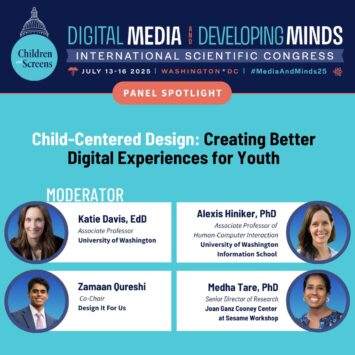
Alexis Hiniker is an Associate Professor of Human-Computer Interaction at the University of Washington Information School, Director of the User Empowerment Lab, and Co-Director of the Center for Digital Youth. She studies the ways in which current technologies harm their users and builds and evaluates alternative systems to demonstrate instead how technology can help young people thrive. She has published more than 80 peer-reviewed papers, which have been featured in mainstream media outlets like The New York Times, TIME Magazine, The Wall Street Journal, and more. Her research has been cited in multiple U.S. state and federal congressional sessions, and she has provided subject-matter expertise on manipulative designs to the White House, the U.S. Department of Justice, and the European Commission. She is a Jacobs Foundation Fellow, a Google Research Scholar, a former advisor to the U.S. Federal Trade Commission, and a recipient of the SIGCHI Societal Impact Award.
Proceedings of the 31st International Conference on Intelligent User Interfaces (IUI 2026). Acceptance rate: 20%.
Proceedings of the 2026 ACM Conference on Human Factors in Computing Systems (CHI 2026). Acceptance rate: 25%.
 Best paper honorable mention (top 5%)

Pediatrics, 157(3):e2025073040, 2026.

Proceedings of the 2026 ACM Conference on Human Factors in Computing Systems (CHI 2026). Acceptance rate: 25%.
Proceedings of the 44th annual ACM Conference on Human Factors in Computing Systems (CHI 2026). Acceptance rate: 25%.
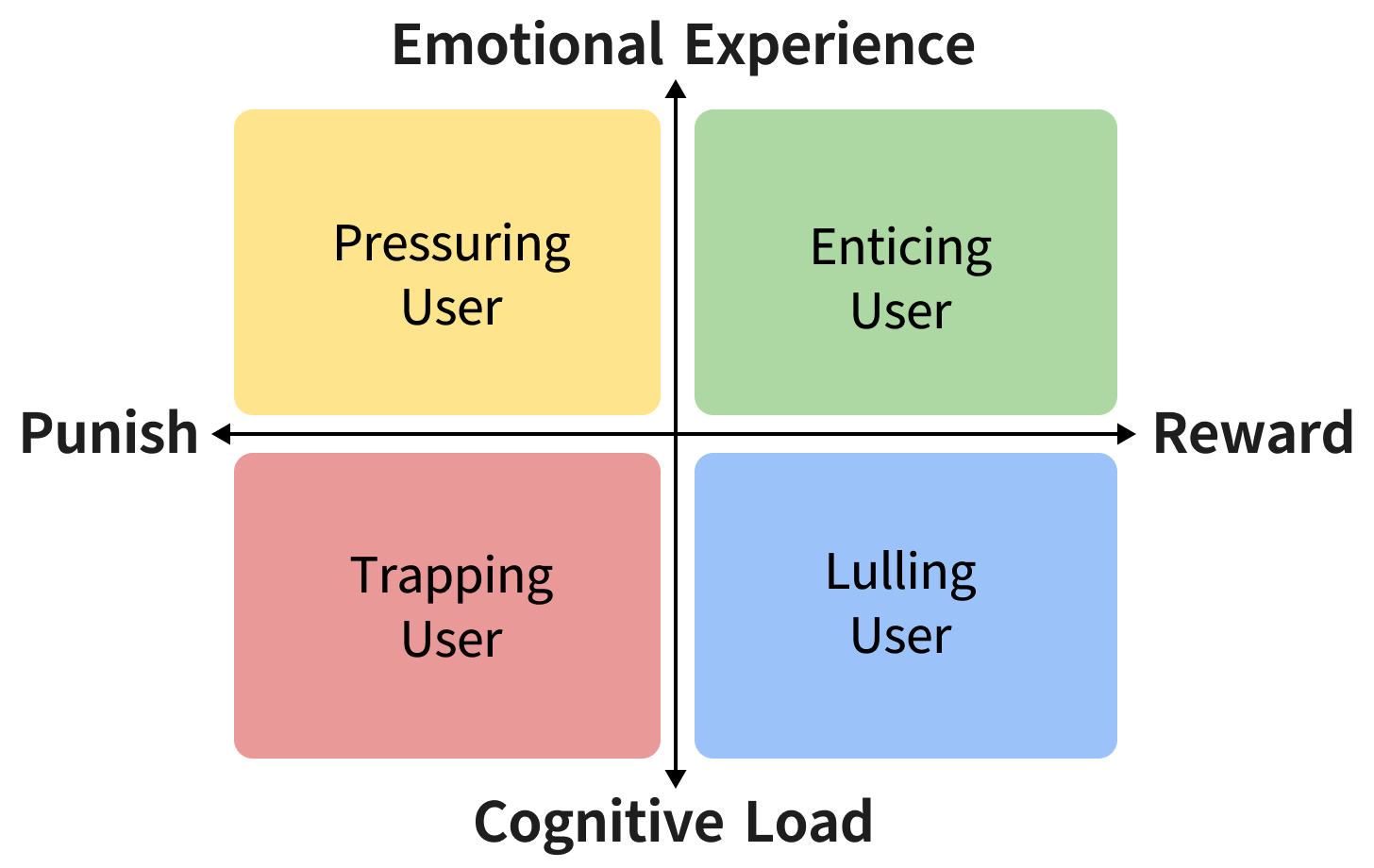
Proceedings of the 2026 ACM Conference on Human Factors in Computing Systems (CHI 2026). Acceptance rate: 25%.

Proceedings of the 2025 AAAI/ACM Conference on AI, Ethics, and Society (AIES 2025). Acceptance rate: 32%.
Proceedings of the 21st Symposium on Usable Privacy and Security (SOUPS 2025).
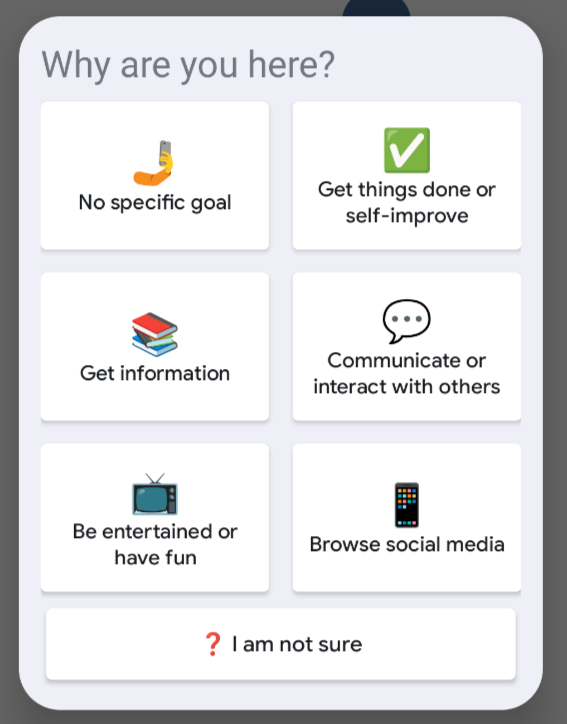
Proceedings of the 2025 ACM Conference on Human Factors in Computing Systems (CHI 2025). Acceptance rate: 25%.

The Journal of Online Trust and Safety (JOTS), 3(1), 2025.
Proceedings of the ACM on Human-Computer Interaction (CSCW), 9(2):CSCW151, 2025.
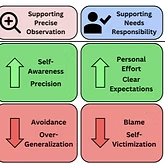
Proceedings of the 2025 AAAI/ACM Conference on AI, Ethics, and Society (AIES 2025). Acceptance rate: 32%.
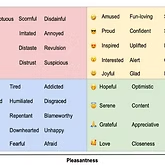
Proceedings of the 2025 ACM Conference on Human Factors in Computing Systems (CHI 2025). Acceptance rate: 25%.

Proceedings of the ACM on Human-Computer Interaction (CSCW), 9(7):1-31, 2025.
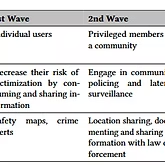
Proceedings of the 2025 ACM Conference on Human Factors in Computing Systems (CHI 2025). Acceptance rate: 25%.
Best paper honorable mention (top 5%)
Proceedings of the 2025 ACM Conference on Human Factors in Computing Systems (CHI 2025). Acceptance rate: 25%.
Proceedings of the ACM on Human-Computer Interaction (CSCW), 8(CSCW2):1-22, 2024.
Proceedings of the 23rd Annual ACM Interaction Design and Children Conference (IDC 2024). Acceptance rate: 29%.

In Proceedings of the 23rd Annual ACM Interaction Design and Children Conference (IDC 2024). Acceptance rate: 29%.

In Proceedings of the 2024 ACM Conference on Designing Interactive Systems (DIS 2024). Acceptance rate: 27%.
International Journal of Human-Computer Interaction (IJHCI), 41(17):1-19, 2024.
Proceedings of the 2024 ACM Conference on Human Factors in Computing Systems (CHI 2024). Acceptance rate: 26%.
Best paper award (top 1%)
Proceedings of the 2024 AAAI/ACM Conference on AI, Ethics, and Society (AIES 2024). Acceptance rate: 38%.
Proceedings of the 2024 AAAI/ACM Conference on AI, Ethics, and Society (AIES 2024). Acceptance rate: 38%.
Proceedings of the 2024 AAAI/ACM Conference on AI, Ethics, and Society (AIES 2024). Acceptance rate: 38%.

Proceedings of the ACM on Human-Computer Interaction (CSCW), 8(CSCW2):1-32, 2024.

In Proceedings of the 22nd Annual ACM Interaction Design and Children Conference (IDC 2023). Acceptance rate: 29%.
Proceedings of the 22nd Annual ACM Interaction Design and Children Conference (IDC 2023). Acceptance rate: 29%.

Proceedings of the 2023 ACM conference on human factors in computing systems (CHI 2023). Acceptance rate: 27.6%.
Best paper honorable mention (top 5%)
Proceedings of the 2023 ACM conference on human factors in computing systems (CHI 2023).
Best paper award (top 1%)
Learning, Media and Technology, 49(2):290–305, 2023.
Proceedings of the ACM on Human-Computer Interaction, 6(CSCW2):1-18, 2022.
Proceedings of the ACM on Interactive, Mobile, Wearable and Ubiquitous Technologies (IMWUT), 6(2):1-23, 2022.
Proceedings of the 2022 ACM conference on human factors in computing systems (CHI 2022). Acceptance rate: 24.7%.
Proceedings of the 2022 ACM conference on human factors in computing systems (CHI 2022). Acceptance rate: 24.7%.
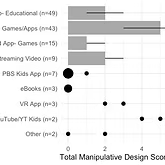
JAMA Network Open, 5(6):e221764, 2022.
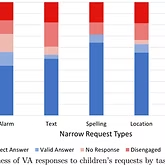
International Journal of Child-Computer Interaction (IJCCI), 34(100540), 2022.
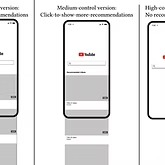
Proceedings of the 2021 ACM conference on human factors in computing systems (CHI 2021). Acceptance rate: 26%.
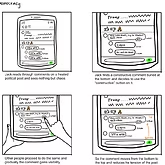
Proceedings of the ACM on Human-Computer Interaction, 5(CSCW1):1-22, 2021.
Proceedings of the ACM on Human-Computer Interaction, 5(CSCW2):1-39, 2021.
Proceedings of the 2021 ACM conference on human factors in computing systems (CHI 2021). Acceptance rate: 26%.
Proceedings of the ACM on Interactive, Mobile, Wearable and Ubiquitous Technologies (IMWUT), 5(3):1-23, 2021.
Proceedings of the 2021 ACM conference on human factors in computing systems (CHI 2021). Acceptance rate: 26%.
Proceedings of the 20th annual ACM conference on interaction design and children (IDC 2021). Acceptance rate: 36%.
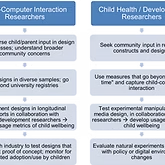
International Journal of Child-Computer Interaction, Special Issue in Review Articles in Child-Computer Interaction Research (IJCCI), 31(100351), 2021.

Proceedings of the 20th annual ACM conference on interaction design and children (IDC 2021).
Proceedings on 20th annual Privacy Enhancing Technologies Symposium (PoPETS), 2020(3):384-403. Acceptance rate: 19%.

Proceedings of the 19th annual ACM conference on interaction design and children (IDC 2020). Acceptance rate: 31%.
Proceedings of the 2020 ACM conference on human factors in computing systems (CHI 2020). Acceptance rate: 24%.

Proceedings of the ACM conference on Designing Interactive Systems (DIS 2020). Acceptance rate: 24%.
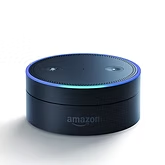
Proceedings of the 2020 ACM conference on human factors in computing systems (CHI 2020). Acceptance rate: 24%.
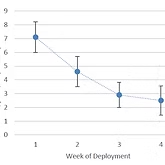
Proceedings of the ACM on Interactive, Mobile, Wearable and Ubiquitous Technologies (IMWUT), 4(1):1-23, 2020.

Proceedings of the ACM on Human-Computer Interaction, CSCW, 3:78(1-22), 2019.
Proceedings of the 18th annual ACM conference on interaction design and children (IDC 2019). Acceptance rate: 31%.
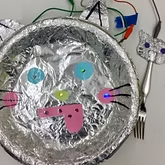
Proceedings of the 13th annual ACM conference on tangible, embedded, and embodied interactions (TEI 2019). Acceptance rate: 34%.
Proceedings of the ACM on Interactive, Mobile, Wearable and Ubiquitous Technologies (IMWUT), 3(1):5, 1-19, 2019.
Proceedings of the 2019 ACM conference on human factors in computing systems (CHI 2019). Acceptance rate: 23%.
Proceedings of the 2019 ACM conference on human factors in computing systems (CHI 2019). Acceptance rate: 23%.
Proceedings of the 2019 ACM conference on human factors in computing systems (CHI ’19), 73:1-15. Acceptance rate: 23%.
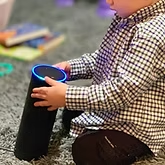
Proceedings of the 2019 ACM conference on human factors in computing systems (CHI 2019). Acceptance rate: 23%.
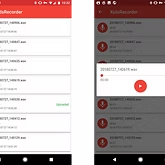
Proceedings of the 2019 ACM conference on human factors in computing systems (CHI 2019). Acceptance rate: 23%.
Best paper award (top 1%)
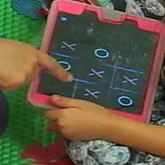
Proceedings of the 2018 ACM Conference on Human Factors in Computing Systems (CHI 2018). Acceptance rate: 25.7%.
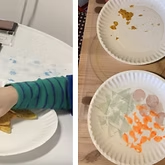
Proceedings of the 19th Annual ACM Interaction Design and Children Conference (IDC 2018). Acceptance rate: 29%.
Proceedings of the 19th Annual ACM Interaction Design and Children Conference (IDC 2018). Acceptance rate: 29%.
Proceedings of the ACM on Interactive, Mobile, Wearable and Ubiquitous Technologies (IMWUT), 2(1):1-26, 2018.
Proceedings of the ACM on Human-Computer Interaction, CSCW, 2(192):1-19, 2018.
Proceedings of the 2018 ACM Conference on Human Factors in Computing Systems (CHI 2018). Acceptance rate: 25.7%.
Best paper honorable mention (top 5%)
Proceedings of the 2017 ACM Conference on Human Factors in Computing Systems (CHI 2017). Acceptance rate: 25%.
Proceedings of the 2017 ACM Conference on Human Factors in Computing Systems (CHI 2017). Acceptance rate: 25%.
Proceedings of the 18th Annual ACM Interaction Design and Children Conference (IDC 2017). Acceptance rate: 21%.
Best paper honorable mention (top three papers)
Journal of the Association for Information Science and Technology (JASIST), 68(10):2338-2349, 2017.
Proceedings of the 19th International ACM SIGACCESS Conference on Computers and Accessibility (ASSETS 2017). Acceptance rate: 22%.
Best paper honorable mention (top seven papers)
Proceedings of the 2016 ACM International Joint Conference on Pervasive and Ubiquitous Computing (UbiComp 2016). Acceptance rate: 26%.
Proceedings of the 2016 ACM Conference on Human Factors in Computing Systems (CHI 2016). Acceptance rate: 23%.
Best paper honorable mention (top 5%)

Proceedings of the 2016 ACM Conference on Human Factors in Computing Systems (CHI 2016). Acceptance rate: 23%.
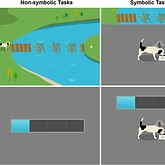
International Journal of Human Computer Studies (IJHCS), 90:53-67, 2016.

Proceedings of the 19th Annual ACM Conference on Computer Supported Cooperative Work (CSCW 2016). Acceptance rate: 25%.
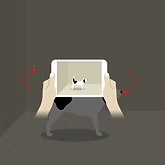
Proceedings of the 16th Annual ACM Interaction Design and Children Conference (IDC 2015). Acceptance rate: 23%.

Proceedings of the 2015 ACM Conference on Human Factors in Computing Systems (CHI 2015). Acceptance rate: 25%.
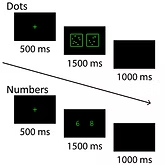
Journal of Autism and Development Disorders (JADD), 46(4):1268-1281, 2015.
Proceedings of the 2014 ACM Conference on Human Factors in Computing Systems (CHI 2014). Acceptance rate: 23%.

Proceedings of the 14th Annual ACM Interaction Design and Children Conference (IDC 2013). Acceptance rate: 33%.