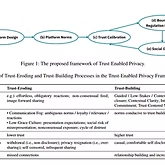
Trust-Enabled Privacy: Social Media Designs to Support Adolescent User Boundary Regulation
Proceedings of the 21st Symposium on Usable Privacy and Security (SOUPS 2025).
Social media has developed a bad reputation for being addictive and harmful to young people. The User Empowerment Lab investigates the design features of social media platforms that contribute to these problems, such as infinite scrolling, autoplay, and algorithmic content recommendations. We conduct experiments to assess the harms caused by specific design features and we design and test alternative patterns that respect users’ attention and can help them thrive. What we find in studying this space is that spending time together with other people online and sharing content with friends enriches people’s lives in many ways, including the lives of young people. The User Empowerment Lab works to design social spaces that encourage users of all ages and young people in particular to spend time with the people they love, have reflective conversations where disagreements are made in good faith and lead to reconciliation, and build communities they trust to protect their privacy.
Proceedings of the 21st Symposium on Usable Privacy and Security (SOUPS 2025).
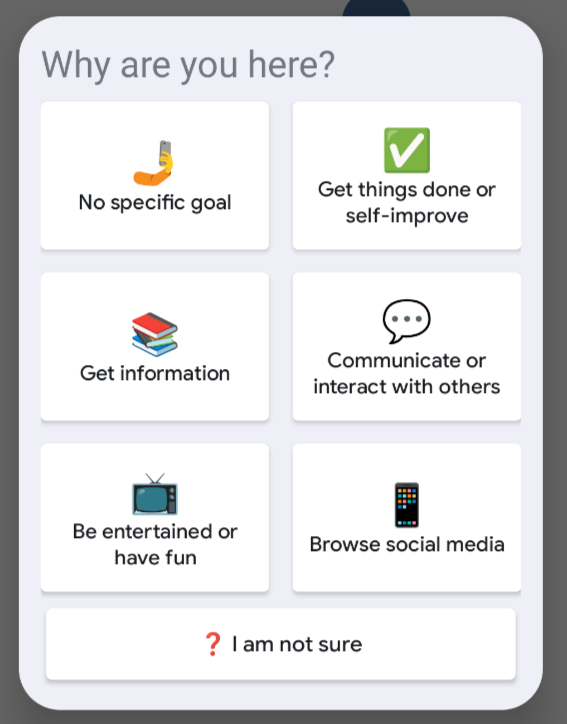
Proceedings of the 2025 ACM Conference on Human Factors in Computing Systems (CHI 2025). Acceptance rate: 25%.
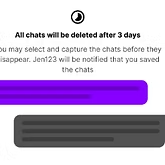
Proceedings of the ACM on Human-Computer Interaction (CSCW), 9(2):CSCW151, 2025.
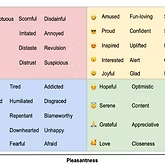
Proceedings of the 2025 ACM Conference on Human Factors in Computing Systems (CHI 2025). Acceptance rate: 25%.
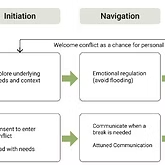
Proceedings of the ACM on Human-Computer Interaction (CSCW), 8(CSCW2):1-22, 2024.
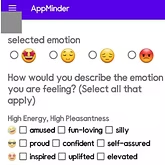
In Proceedings of the 23rd Annual ACM Interaction Design and Children Conference (IDC 2024). Acceptance rate: 29%.

In Proceedings of the 2024 ACM Conference on Designing Interactive Systems (DIS 2024). Acceptance rate: 27%.

Proceedings of the ACM on Human-Computer Interaction (CSCW), 8(CSCW2):1-32, 2024.
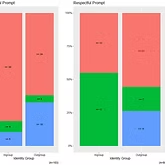
Proceedings of the ACM on Human-Computer Interaction, 6(CSCW2):1-18, 2022.
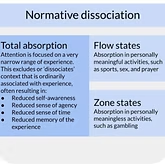
Proceedings of the 2022 ACM conference on human factors in computing systems (CHI 2022). Acceptance rate: 24.7%.
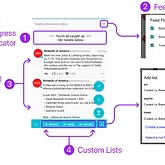
Proceedings of the 2022 ACM conference on human factors in computing systems (CHI 2022). Acceptance rate: 24.7%.
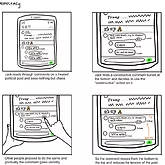
Proceedings of the ACM on Human-Computer Interaction, 5(CSCW1):1-22, 2021.
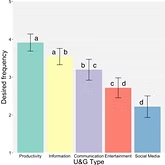
Proceedings of the ACM on Interactive, Mobile, Wearable and Ubiquitous Technologies (IMWUT), 2(1):1-26, 2018.
TODO: Related News