
SusBench: An Online Benchmark for Evaluating Dark Pattern Susceptibility of Computer-Use Agents
Proceedings of the 31st International Conference on Intelligent User Interfaces (IUI 2026). Acceptance rate: 20%.
Deceptive designs, also referred to as “dark patterns,” are user interface designs that use psychological tricks to manipulate users into taking actions that serve the product’s interests rather than their own. These designs often seek to extract money, time, or data from their users. The User Empowerment Lab examines deceptive designs in many different contexts, including social media platforms, games, eCommerce sites, and AI chatbots. We conduct experiments to assess the harms caused by specific deceptive designs and we design and test alternative patterns that respect users’ interests.
Proceedings of the 31st International Conference on Intelligent User Interfaces (IUI 2026). Acceptance rate: 20%.

Pediatrics, 157(3):e2025073040, 2026.
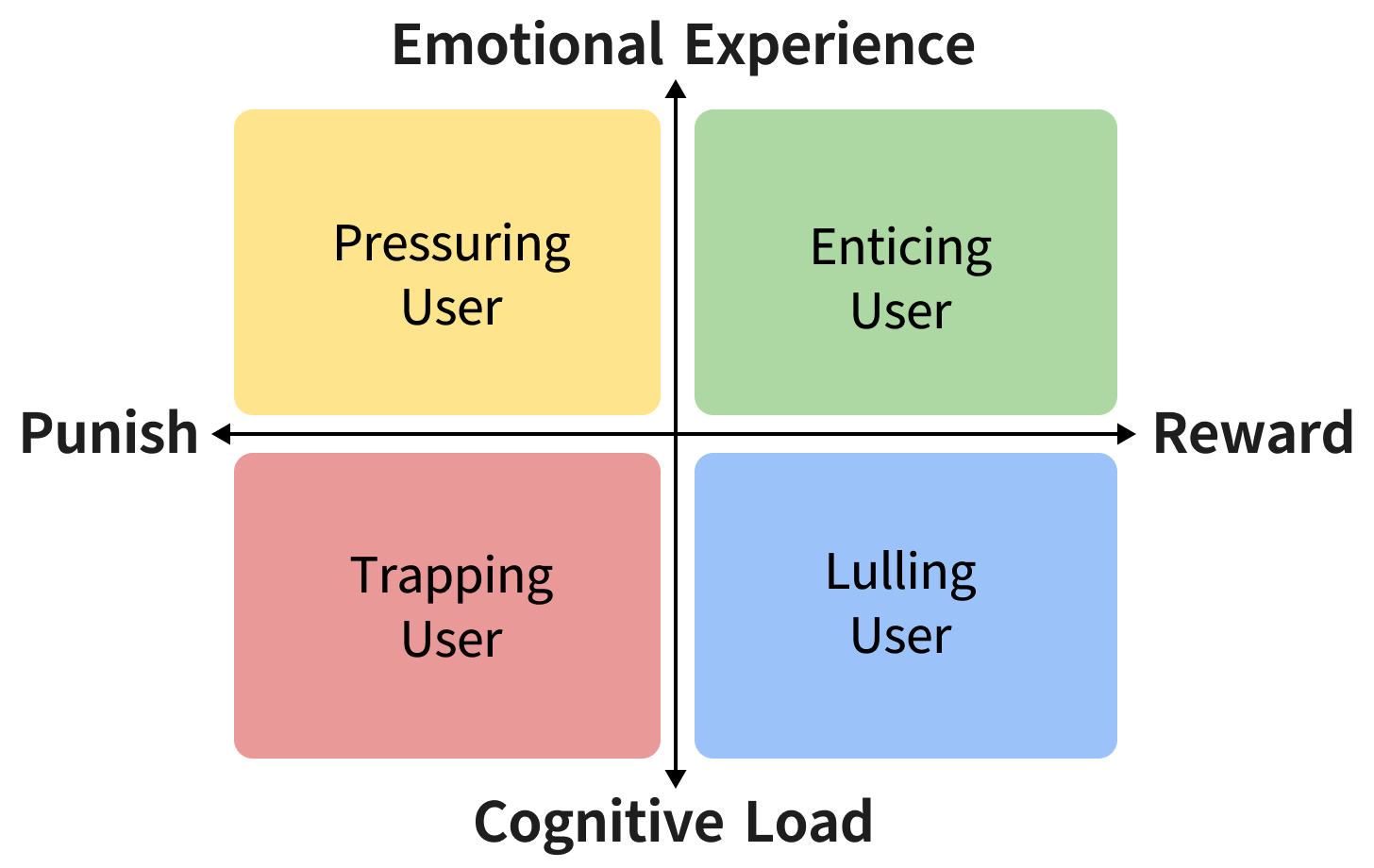
Proceedings of the 2026 ACM Conference on Human Factors in Computing Systems (CHI 2026). Acceptance rate: 25%.

Proceedings of the 21st Symposium on Usable Privacy and Security (SOUPS 2025).
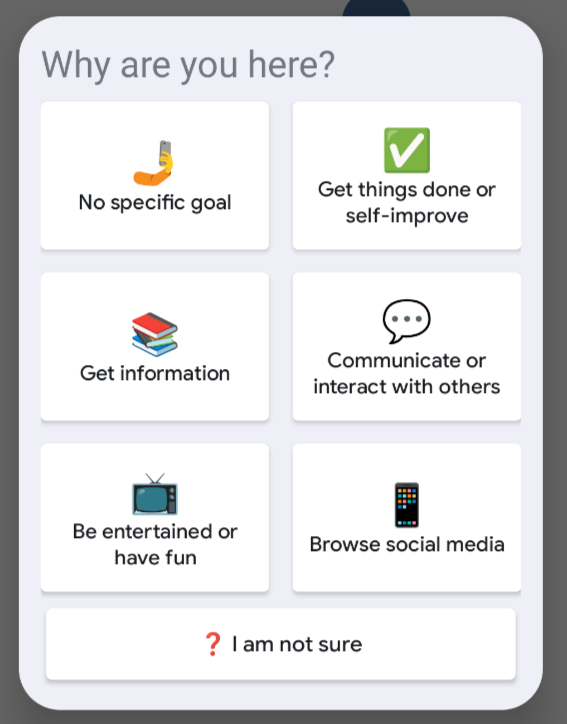
Proceedings of the 2025 ACM Conference on Human Factors in Computing Systems (CHI 2025). Acceptance rate: 25%.

The Journal of Online Trust and Safety (JOTS), 3(1), 2025.
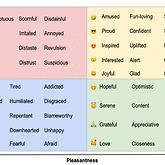
Proceedings of the 2025 ACM Conference on Human Factors in Computing Systems (CHI 2025). Acceptance rate: 25%.
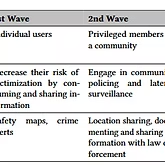
Proceedings of the 2025 ACM Conference on Human Factors in Computing Systems (CHI 2025). Acceptance rate: 25%.
 Best paper honorable mention (top 5%)
Proceedings of the 23rd Annual ACM Interaction Design and Children Conference (IDC 2024). Acceptance rate: 29%.

In Proceedings of the 23rd Annual ACM Interaction Design and Children Conference (IDC 2024). Acceptance rate: 29%.

In Proceedings of the 2024 ACM Conference on Designing Interactive Systems (DIS 2024). Acceptance rate: 27%.
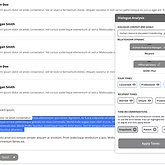
Proceedings of the 2024 ACM Conference on Human Factors in Computing Systems (CHI 2024). Acceptance rate: 26%.
Best paper award (top 1%)

Proceedings of the ACM on Human-Computer Interaction (CSCW), 8(CSCW2):1-32, 2024.
Proceedings of the 22nd Annual ACM Interaction Design and Children Conference (IDC 2023). Acceptance rate: 29%.

Proceedings of the 2023 ACM conference on human factors in computing systems (CHI 2023). Acceptance rate: 27.6%.
Best paper honorable mention (top 5%)
Proceedings of the 2023 ACM conference on human factors in computing systems (CHI 2023).
Best paper award (top 1%)
Proceedings of the ACM on Human-Computer Interaction, 6(CSCW2):1-18, 2022.
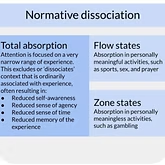
Proceedings of the 2022 ACM conference on human factors in computing systems (CHI 2022). Acceptance rate: 24.7%.
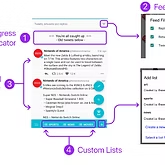
Proceedings of the 2022 ACM conference on human factors in computing systems (CHI 2022). Acceptance rate: 24.7%.
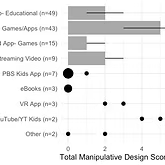
JAMA Network Open, 5(6):e221764, 2022.
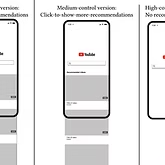
Proceedings of the 2021 ACM conference on human factors in computing systems (CHI 2021). Acceptance rate: 26%.
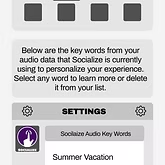
Proceedings of the ACM on Interactive, Mobile, Wearable and Ubiquitous Technologies (IMWUT), 5(3):1-23, 2021.
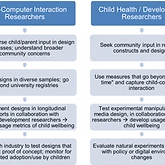
International Journal of Child-Computer Interaction, Special Issue in Review Articles in Child-Computer Interaction Research (IJCCI), 31(100351), 2021.
Proceedings of the 2019 ACM conference on human factors in computing systems (CHI 2019). Acceptance rate: 23%.
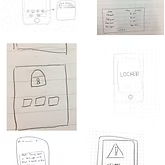
Proceedings of the 2019 ACM conference on human factors in computing systems (CHI 2019). Acceptance rate: 23%.
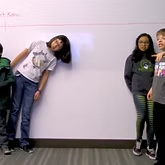
Proceedings of the 2019 ACM conference on human factors in computing systems (CHI ’19), 73:1-15. Acceptance rate: 23%.
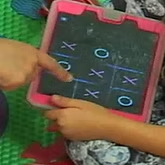
Proceedings of the 2018 ACM Conference on Human Factors in Computing Systems (CHI 2018). Acceptance rate: 25.7%.
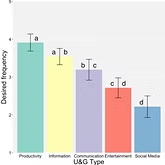
Proceedings of the ACM on Interactive, Mobile, Wearable and Ubiquitous Technologies (IMWUT), 2(1):1-26, 2018.
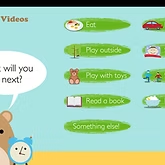
Proceedings of the 2018 ACM Conference on Human Factors in Computing Systems (CHI 2018). Acceptance rate: 25.7%.
Best paper honorable mention (top 5%)
Proceedings of the 2016 ACM International Joint Conference on Pervasive and Ubiquitous Computing (UbiComp 2016). Acceptance rate: 26%.
TODO: Related News